Itinerary— all
Akita, Japan: Sake, Samurai Districts, and Lanterns at Night
May 26, 2026
Akita produces Japan's finest sake, preserves one of its best samurai districts, and hosts the Kanto Festival — one of August's great spectacles. Here is the complete guide.
Akita Prefecture sits on the Sea of Japan coast of northern Honshu, separated from Iwate and Miyagi on the Pacific side by the Ou Mountain range. The geography shapes everything: the winters are among Japan's heaviest in snowfall, the rice grows in water fed by snowmelt, the cedar forests are dense and old. The prefecture produces the conditions for excellent sake and the isolation that made its samurai culture distinct.
Internationally, Akita is known for three things: the Kanto Festival, Nyuto Onsen, and Kakunodate. Each is a genuine reason to visit. Together, they make Akita one of the most rewarding prefectures in Tohoku for a traveler who wants to understand Japan rather than catalogue it.
Kakunodate: Japan's Best-Preserved Samurai Town
Kakunodate, in the Senboku region of central Akita, was established as a castle town in 1620. The samurai quarter — bukeyashiki — survives almost intact: a wide main street lined with black-walled samurai residences, their gardens visible through gates, their weeping cherry trees overhanging the avenue. Six of the residences are open to visitors; they contain armor, furniture, and domestic objects that document samurai life across three centuries.
The cherry blossom season at Kakunodate (late April) is among Japan's most celebrated — the combination of weeping cherries along the samurai street and the Hinokinai River is reproduced in photographs worldwide. But the town rewards a visit in any season. In winter, the black walls and heavy snow create a monochrome stillness. In autumn, the maples in the samurai garden turn gold above the old walls.
Beyond the bukeyashiki, the merchant district south of the samurai quarter shows a different layer of Kakunodate life. Craft shops selling kabazaiku — objects made from cherry bark, a technique unique to the town — line the narrow streets. The bark is used to wrap wooden objects: tea caddies, pen cases, letter boxes. The craft has been practiced in Kakunodate for 300 years and remains active.
Onsen
Nyuto Onsen: The Thatched-Roof Baths at the End of the Mountain Road
Seven ryokan, seven springs, one mountain in Akita. Nyuto Onsen is Japan's finest onsen district — and one of its least internationally known.
The Kanto Festival
The Akita Kanto Festival runs August 3–6. The Kanto is a 12-metre bamboo pole hung with 46 paper lanterns in a structure of cross-branches — the assembled pole weighs 50 kilograms. Performers balance this on their foreheads, then their shoulders, then their open palm, their lower back. The skill takes years to develop; the training begins in childhood.
The evening parades run along Kanto Odori, the main avenue, for two hours from 7:15pm each night of the festival. Approximately 270 kanto are performed simultaneously — the combined light of nearly 10,000 lanterns moving against the dark sky is a spectacle of a different quality from any festival photograph. The festival concludes with a morning event on August 7 in which the performers compete for technical excellence.
Tickets for grandstand seating are available through the festival office (apply in advance). Standing along the avenue is free. Arrive by 6pm for a good standing position.
Nyuto Onsen
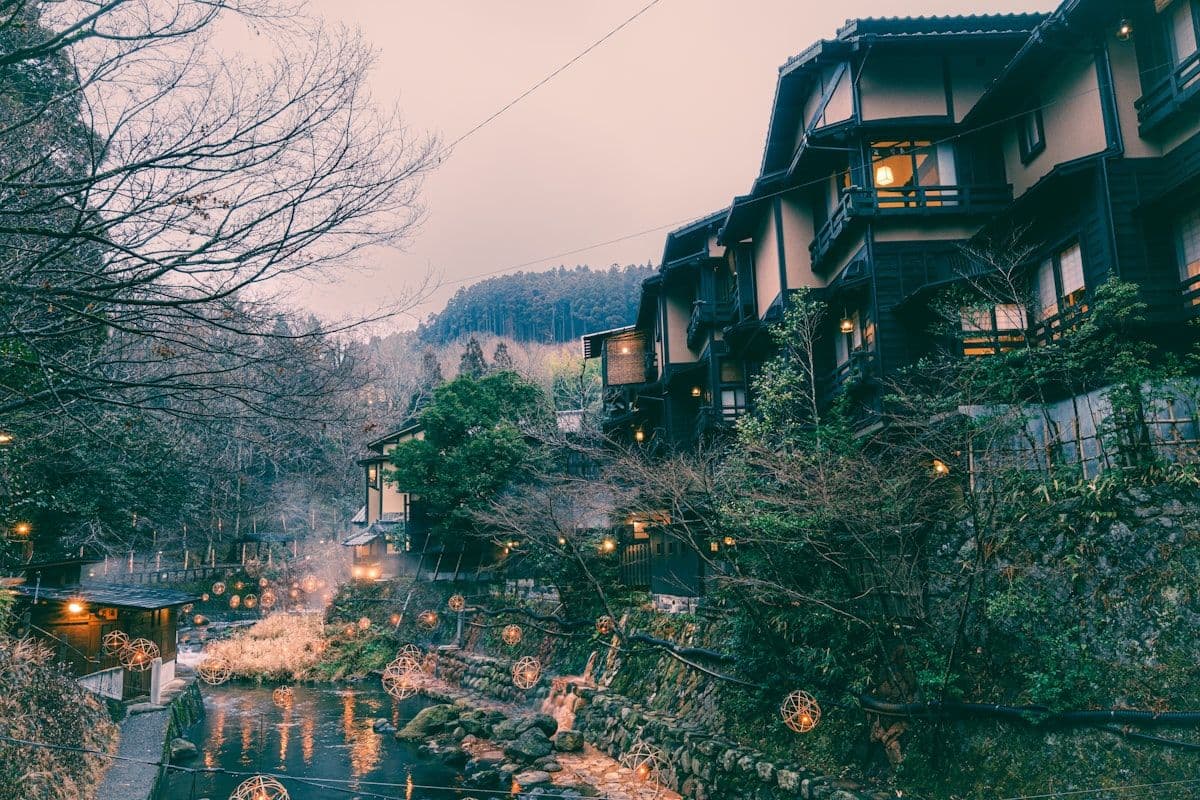
The Nyuto Onsen cluster — seven ryokan sharing a mountainside east of Tazawako lake — is Akita's most famous onsen destination and among the finest in Japan. Each ryokan has its own spring with its own mineral character: milky white at Tsurunoyu, iron-brown at Magoroku, clear and soft at Ganiba. The meguri pass allows access to all seven baths in a single day.
Tsurunoyu is the headline: outdoor mixed baths fed by an alkaline spring that turns the water ivory, the surrounding forest, the thatched rooftops. Book at least three months ahead for weekends in autumn or winter. The other six ryokan offer comparable bathing quality with shorter booking windows.
Akita's Sake
Akita Prefecture produces sake with a character that reflects its water and climate: soft water from snowmelt creates sake with a gentle, round mouthfeel. The prefecture has pioneered the "junmai daiginjo" style — highly polished rice, slow fermentation — and produces a disproportionate number of Japan's award-winning breweries.
Recommended breweries for visits: Yukinobosha (Sakata area, near Yamagata border), Kariho (Daisen city), Masumi (Suwa, technically Nagano — but widely available in Akita and a useful reference point for comparison). Several breweries in Yokote and Daisen city accept visitors with advance contact.
Getting Around Akita
The Akita Shinkansen (Komachi line) runs from Tokyo to Akita city (3 hours 45 minutes). From Akita city, the Ou Main Line connects south to Yokote and Kakunodate. For Kakunodate specifically, the Akita Shinkansen also stops there directly (2 hours 50 minutes from Tokyo). Tazawako Station (for Nyuto Onsen) is on the shinkansen; bus from there.